PapayaDB
Repository of cathepsin-glycosaminoglycan in silico interactions
A curated computational resource for exploring structural models, simulation-derived descriptors and interaction patterns of cathepsin–glycosaminoglycan complexes.
What is PapayaDB?
A molecular-dynamics derived PapayaDB organizes cathepsin–GAG systems into approach-specific records linking proteins, glycosaminoglycans, chain lengths, simulation protocols and downloadable analysis outputs. The database is designed to support comparative interpretation of GAG recognition across the human cysteine cathepsin family.
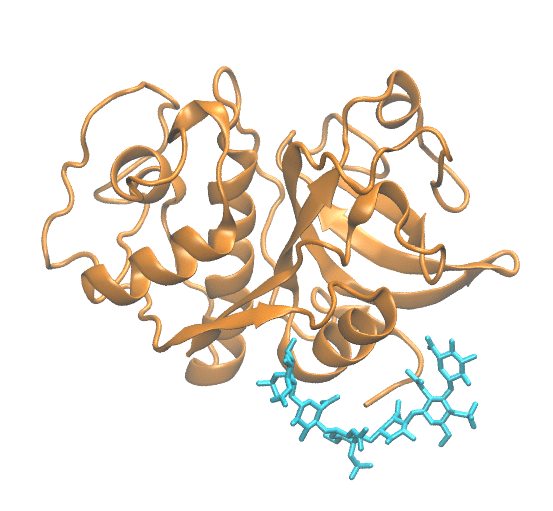 Cathepsin K - CS4 dp6
Database coverage
Dataset availability notice
Coverage numbers refer to generated PapayaDB simulation datasets. Public record upload and validation are ongoing, and the complete dataset is expected to be available by autumn 2026.
Three complementary simulation datasets
PapayaDB combines multiscale simulation approaches to capture interaction details and conformational behaviour of cathepsin–GAG complexes.
All-atom MD
High-resolution simulations of short cathepsin–GAG oligosaccharide complexes, providing detailed structural and interaction descriptors.
RS-REMD
Enhanced-sampling simulations designed to explore broader conformational landscapes of longer GAG chains for each cathepsin–GAG pair.
Coarse-grained MD
Extended-timescale simulations of cathepsin–heparin systems using a SUGRES-compatible heparin representation.
What is inside a PapayaDB record?
PapayaDB records are organized at complex, cluster and representative simulation levels.
Cathepsin, GAG class, chain length and dataset type.
Docking-derived binding-pose groups describing alternative interaction regions.
Selected structures used for molecular dynamics and downstream analysis.
RMSD, MM-GBSA, LIE, hydrogen bonds, contact maps, plots and CSV files.
From structures to interpretable records
The all-atom dataset follows a multi-stage computational workflow combining electrostatic potential analysis, molecular docking, clustering, representative pose selection and molecular dynamics simulations.
Explore PapayaDB
Cathepsins
Protein targets, structural templates, electrostatic potential isosurfaces and available complexes.
Browse CathepsinsComplex records
Complex-level records, clusters, representatives and simulation-derived outputs.
Explore ComplexesDevelopment status
PapayaDB is currently under development. The associated manuscript is planned to be submitted in October 2026. For citation, collaboration or early-use questions, contact contact@papayadb.org.